

When you consider sewing or creating clothes, you may think of something bright and colorful, some fancy fabrics or beautiful patterns. It is the magic of something less obvious, though, the seams, the very lines where the fabrics meet and are glued. These are the seams, also referred to as Nahttypen in German, which form the basis of any sewing undertaking, whether it is a beginner who is making his initial project or an expert who is making high-end fashion.
Nahttypen (seam types) are not merely the lines of sewing, but are the supportive elements that make garments and textile works strong, shaped, and styled. The kind of seam you use may influence the durability, comfort as well as the appearance of your finished piece of work.
You will learn all about the types of seams, the most popular ones, and how to select the right type when you have a fabric and project in this guide, and the tips that will help you sew them without being afraid. Simple seams that are easy to do, and complicated sewing techniques applied in industrial sewing, the knowledge of Nahttypen will make your sewing easier and the garments last longer.
What Are Nahttypen (Seam Types)?
Nahttypen is a German term, which in the English language means seam types. Nahttypen are the various techniques of connecting pieces of fabric before sewing, in textile manufacturing. These types of seams are critical in defining the strength, flexibility, looks, as well as the overall functionality of the end garment or the end product of the textile.
A seam is not merely a plain piece of stitches; it is the support of any piece of sewing, whether it will stand long to wear and washing, move with the dress, and appearance. There are various types of seams that are applied with a particular purpose in case of different fabrics, intended use of the garment and the desired look.
There are some typical types of nahttypen: straight seams in case of woven clothes, zigzag in the case of stretchable materials, overlock in the case of finishing edges, French in the case of delicate fabrics and flatlock in the case of activewear to allow comfort and flexibility.
To have projects that are durable, comfortable, and stylish, the appropriate nahttyp needs to be selected. Hand-sewing, machine sewing, or working in the garment-producing area of an industry, you will with all the types of seams, improve the quality and look of your cloth.
Diverse types of seams and their possible uses can be studied with the help of helpful guides and tutorials, and make your sewing projects the source of professional and long-lasting results.
Also Read More: YWMLFZ 48W Cordless Nail Lamp
Why Understanding Nahttypen Matters
The knowledge of Nahttypen (seam types) is important since seams are the foundation of any garment or textile product. Here’s why it matters:
- Durability and Strength: The right seam is made to make sure that your garment is strong enough to withstand any stress, wear and washing without tearing. As an example the heavy workwear requires the strong seams such as the flat-felled seam, whereas the delicate ones require more delicate seams such as the French seams.
- Appearance and Style: Seams determine the appearance of the garment both on the inside and outside. The decorative seams are visible which adds more style to it and the non visible seams are what give it smooth and polished finish. And the selection of the appropriate seam not only increases functionality but design influence, too.
- Comfort and Fit: Seams influence the way in which clothes fit and touch the body. Stretchy materials need a flexible seam such as overlock or zigzag so that they can stretch together with the wearer. Inappropriate choice of seam may result into pain or immobilization.
- Garment Longevity: Well chosen and sewn seams will help avoid some common issues such as fraying, puckering and seam slippage, which will add longevity to your garments.
- Professional Quality: To the designer and sewers who want to be distinguished in terms of quality, it is therefore important to learn the different types of seams so that the clothes they make not only satisfy the aesthetics but also the functionality.
- Efficiency and Suitability: In the manufacturing environment, certain types of seams accelerate the processing process and suit the fabric needs balancing the price, durability and appearance.
A Brief History of Seams
The history of seams is as ancient as clothes. Thousand of years ago, man started sewing to combine the elements of animal skin and fabrics. The initial seams were stitched with bone or wooden needles and natural fibers and had both utilitarian and ornamental purposes.
With advancement in civilizations, sewing process became advanced. The ancient Greeks, Romans, and Egyptians invented customized clothes using the carefully made seams to fit and last. Social status reflected itself in decorative and reinforcing stitches to develop seam construction in the Middle Ages. Tailors got the craft of an art and mastered the seam forms that were strong and graceful at the same time.
The Industrial Revolution brought about the use of sewing machines and transformed the process of sewing. Machines would be able to perform tasks that would have required hours of human labor, do it in an efficient and uniform manner, and produce clothes in large quantities. It was a period that witnessed the creation of special seams such as the flat-felled seam used in denim and overlocking to stop tearing.
Bonded seams, heat-sealed seams, laser-cut seams are some of the new technologies of the modern era which have widened the possibilities regarding functionality and fashion. Seam technologies keep on changing with sustainability and smart textiles, which have formed how we wear and make fashion in our present days.
Common Nahttypen Explained
It is important to know the various types of seams in order to make a garment that is not only beautiful but also durable and comfortable. The most typical nahttypen used in sewing include the following:
- Plain Seam (Offene Naht)
The simplest and the most common seam would be the plain one. In it, two pieces of fabric are laid one upon the other with right sides facing and a straight stitch is done along the edge. It is fast and simple and that is why this seam is preferred by both beginners and professionals. It fits best with woven clothes such as cotton shirts, skirts, and pants. Nonetheless, due to the fact that the edges of the raw fabric are open internally, finishing methods such as zigzag or overlocking are frequently employed to avoid fraying. - French Seam (Französische Naht)
When you are dealing with light, sheer materials such as silk, chiffon, etc. the French seam is your preferred choice. This seam is used to hide the raw edges in two rows of stitches which are then a clean, strong finish that is professional looking on both sides. It involves sewing wrong sides together and then the seam allowance is trimmed and then the process is repeated again by sewing right sides together and then it covers the raw edges. Lingerie, wedding dresses, and blouses with a need to have a perfect internal finish are the most common applications of this seam. - Flat-Felled Seam (Kappnaht)
In use in denim jeans and in work wear, the flat-fell seam is renowned as being very durable. It is a process of folding and encircing unrefined edges and double stitching which is flat against the material. It is a seam that is very strong and can resist fraying and therefore suits garments that are used intensively in terms of wear and tear. The traditional appearance of this seam is also a style of casual and outdoor attire. - Overlock Seam (Overlocknaht)
The overlock seam is made by using the serger machine which stitches, cuts and finishes edges all together. It works particularly well with knit clothes or stretchy clothes because it is stretchy and will not unravel. Overlock seams provide the appearance of clean professional fashion fast and efficiently and are overall utilized in t-shirts, sportswear as well as the fashion industry. - Bound Seam (Belegnaht)
The fabric strips or bias tape are used to cover raw edges completely in a bound seam. This method does not only help in avoiding fraying but it also has a decorative effect usually found in expensive garments as well as unlined jackets. The binding is then sewn in making the binding tight, crisp but very durable and stylish. - Lapped Seam (Aufgesetzte Naht)
The lapped seam involves overlapping of one of the fabric edges over another and stitching them into place leaving no uncut edges. The seam is preferred in leather work, sportswear and heavy fabric where the seam should be robust but flat. The overlapping technique also introduces an element of decoration and is also able to reduce the stress on seams.
Essential Tools and Tips for Seam Success
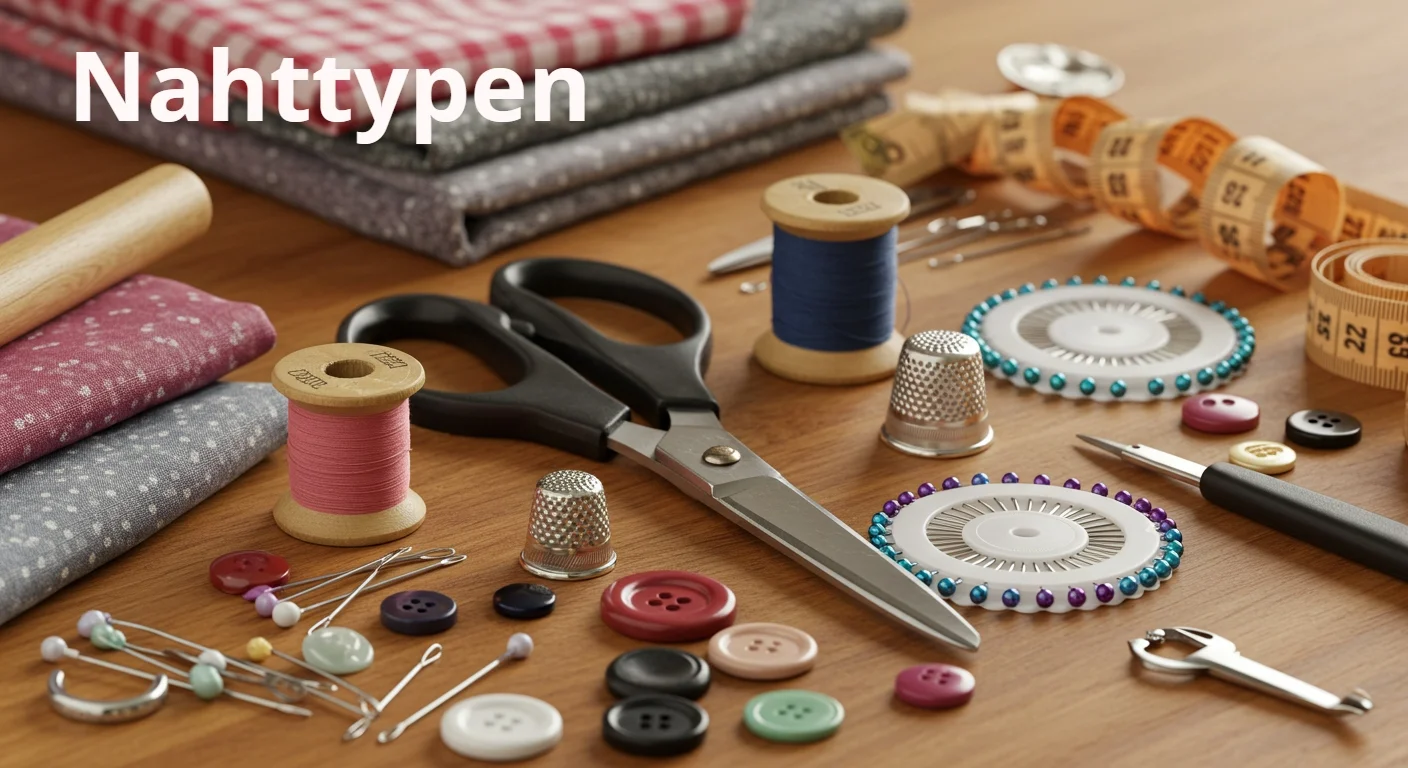
The nahttypen is the sewing of beautiful and durable seams that require the right tools and techniques. You can be an amateur or just need to sharpen the tool, but having the necessary equipment and adhering to the best practice does not leave any indifferent.
Essentials of Seam Sewing
- Sewing Machine: It is a quality sewing machine with the right type of fabric. Machines that have variable stitch length and tension controls provide more precision and strength of the seams. In finishing edges, serger or overlock machine is invaluable particularly in knitwear.
- Needles: It is important to use the correct type and size of a needle. Strong denim needles should be used with heavy fabrics and wear such as denim whereas fine, sharp needles should be used with fine silks to avoid destruction.
- Thread: Select good thread that suits your fabric. Polyester has strength, flexibility and cotton threads are suitable to natural fabrics that have lower stretch.
- Measuring Instruments: Seam allowances should be measured precisely–seam gauges, measuring tapes, or rulers can be used to mark seam-lines and keep them well constant.
- Pins and Clips: To keep the fabrics in place, sharpshooting pins or clips must be used to ensure they do not move during sewing. Thick fabrics that would have holes left by pins can be used with clips.
- Scissors and Rotary Cutters: Fabric scissors sharp blades are used to make clean cuts whereas rotary cutters are used to make straight edges and curves.
- Iron and Pressing Tools: Pressing the seam is a technique used to flatten and leave open during sewing to get professional finishes. An iron and a pressing cloth are a good protecting cloth to take care of the fabrics during this process.
Pro Tips for Seam Success
- Test Before Sewing: It is always important to sew samples on scrap fabric beforehand. This assists in calibration of tension, stitch length and compatibility of the needles to eliminate errors.
- Stay glued to Seam Allowance: Seam allowances should also be maintained; uniform with guides or markings, uneven seams result in weakening of garments and affect fitting.
- Press as You Sew: When stitching, it is better to press open seams or press to one side so the sewing has no bulk and is sturdier and looks clean.
- Apply Stitch Lengths: The longer the better the fabric and basting; the shorter the better the stability of heavy or stressed areas.
- Periodic Cleaning and Removal of Oil: Clean your machine and keep it well oiled and replace needles frequently to prevent skipped stitches and tie-down of the fabric.
- Finish Edges: do not fray, edge seam ends by zigzag stitching, overlocking, or binding.
Advanced Seam Techniques and Innovations
With the advancement in sewing technology, the variety of nahttypen (types of seams) is also expanding beyond the traditional sewn ones. These new technologies optimize the functionality, durability and aesthetics of garments and fulfill the current requirements of sustainability and intelligent fabrics.
- Bonded Seams
Among the game-changing innovations is the bonded seams. Rather than sewn stitches, fabrics have been joined with adhesives or heat-activated tapes, which melt to form a waterproof and airtight connection. Bonded seams are known to have extensive applications in outdoor apparel, rain coats and in performance sports attire where waterproofing is vital. The process removes the thick sewing lines, thus rendering clothes thin and smooth. - Laser-Cut and Welded Seams
Laser cutting and sewn-in seams have been adopted in industrial sewing as a precision tool. The laser cutters cut the fabric with clean cuts that have no fray and the welded seams fuse the fabrics using heat or ultrasonic waves. These inventions give way to smooth, cozy and extremely durable clothes commonly found in swimwear and technical sportswear. - Flatlock Seams
Flatlock seams Flatlock seams are an amalgamation of flat, smooth finishes and stretchability. These seams are formed by stitching the edges of the fabric together and stitching them flat with special machine, thus minimizing mass and discomfort. Flatlock seams are also popular in activewear and underwear and can be used to add stretch and mobility with a similar appearance of decoration. - Smart Seams
Smart seams is a new branch of the sewing industry that incorporates sensors, conductive threads or fabrics into seams in order to record health, posture or environmental status. These seams make clothing interactive, data gathering devices and stretch the limits of fashion to the wearable as technology. - Sustainable Seam Practices
Nahtptonen innovations are also being influenced by sustainability. Ecological seam methods are aimed at decreasing waste of fabrics, energy and chemical. New technologies encompass zero-waste pattern-making accompanied by seams that need minimal finishing, and biodegradable seam tapes and threads. - Precision Machinery
The sewing machines of the modern world are now computerized and automatically set the types, lengths or tension of stitches depending on the type of fabric and the type of seam chosen. This semi- or fully automatic sewing improves the quality control, speed and consistency in large-scale production.
FAQs
Which seam is the easiest one to wear?
Plain seam is the simplest one to sew and is compatible with most woven materials such as cotton. It is an excellent place where new sewers can get basic skills.
What can I do to avoid the fraying of seams?
You should always sew the ends of your seams in a particular way like overlocking, zigzag stitching or binding. Exquisite finishing keeps the seams on and your garment longer.
What seam is the most suitable with stretchy materials such as activewear?
Zigzag or overlock seams are the best as they stretch along with the fabric avoiding thread breakage and thread splitting.
What is special about French seams?
The French seams are used to cover the raw edges giving a clean and elegant appearance. They suit fine or light clothes and provide stability and professionalism to the clothes.
During jeans and heavy-duty garments, why are the seams fashioned flat-felled?
The seams in flat felled are doubly stitched covering of raw edges and offer remarkable strength and stability. They are made in such a way that they do not break up when exposed to excessive wear and tension.
Conclusion
Learning and familiarizing oneself with the various types of nahttypen (seam types) is the norm of every serious sewer, a beginner or an old tailor. Seams are not merely useful components which hold your pieces of fabric in place but they are also essential to the longevity, comfort, appearance, and fit of your clothing.
Simple plain seams to the complex bonded and smart seams, each type of seam has its purpose depending on the type of fabric and the use of a garment. When and how to apply each seam will make you a better craftsman and give you a professional result each time you work.
With the correct tools, understanding of the most frequent errors, and information about novel seam technologies, you can be certain to approach any sewing project and produce clothes that can indeed stand the test of time.
Also Read More: Demainmail


